
Aerial view over Padar Island's ridges and curved bays in Komodo National Park, with boats anchored offshore
Photo: Simon Spring on Unsplash.

Padar Island Itinerary: 1, 2 & 3 Day Plans

Most travellers need 1 day for a Padar Island sunrise hike alone, 3 days 2 nights to combine it comfortably with Komodo dragons, Rinca, Pink Beach and Manta Point, and 5–7 days to add Raja Ampat–style island-hopping or a slower liveaboard pace. Below are hour-by-hour plans for 1D, 2D1N, 3D2N and 4D3N.

Illustration of a generic three-stage trip timeline with sunrise, tent and flag icons
Illustration of a 1-, 2- and 3-day trip timeline to Padar Island.

How long do you need for Padar Island?

Padar’s summit hike itself takes 25–45 minutes each way for most visitors, so the island doesn’t demand multiple days on its own. What determines your trip length is everything around it: how many other Komodo National Park sites you want to combine, whether you’re on a speedboat or a slower phinisi, and whether you want the sunrise light (which means an overnight stay near the park, not a same-day flight-in-flight-out visit).

Trip lengthWhat it coversBoat type usually used
1 dayPadar sunrise hike only, or Padar + one nearby stopSpeedboat, shared or private
2D1NPadar + Komodo dragons + Pink BeachSpeedboat or small phinisi
3D2NPadar + Komodo + Rinca + Pink Beach + Manta Point + Taka MakassarPhinisi, shared open-trip or private
4D3N3D2N route plus Kelor, Kanawa or Gili Lawa, at a slower pacePhinisi, private preferred
5–7 daysFull Komodo archipelago plus Kalong, Rinca, Batu Cermin, or a Bali–Komodo overland+sail combinationLiveaboard or private phinisi charter

One-day Padar Island itinerary

This is the sunrise-hike day trip, run almost entirely by speedboat from Labuan Bajo. The window is tight because Padar’s light is best in the first hour after sunrise and the boat has other stops to make.

TimeActivity
04:00–04:30Hotel pickup in Labuan Bajo, transfer to harbour
04:30–07:00Speedboat crossing to Padar (roughly 60–120 minutes depending on boat and sea conditions)
07:00–08:15Landing, hike to the summit viewpoint (25–45 minutes up, steady pace), photos at the top
08:15–09:00Descend, board boat
09:00–11:30Sail to a second stop — commonly Pink Beach for swimming and snorkelling
11:30–12:30Lunch aboard or on the beach
12:30–15:30Return crossing to Labuan Bajo
15:30Drop-off at hotel or harbour

Because this itinerary front-loads a 2.5-hour crossing before sunrise, an early departure that slips by even 30 minutes can cost you the best light at the summit — worth confirming departure time directly with your operator the night before. For the fully expanded version of this plan, including what happens when a boat runs late, see the one-day Padar itinerary guide.

A visitor standing on a rocky outcrop on Padar Island's ridge, looking out over a curved bay and the island's peaks
Visitors taking in the view from Padar’s summit, with the three bays that are the highlight of the one-day route. Photo: Killian Pham/Unsplash.

2 Days, 1 Night itinerary

Adding one overnight lets you sleep closer to the park (either aboard a small boat or back in Labuan Bajo) and split the sunrise hike from the Komodo dragon trek, so neither feels rushed.

DayPlan
Day 1Depart Labuan Bajo late morning, sail to Rinca Island for a Komodo dragon ranger-guided trek, then to Kalong Island at dusk to watch the flying-fox colony leave for the night. Overnight aboard boat or return to Labuan Bajo.
Day 2Pre-dawn departure for Padar sunrise hike, then Pink Beach for swimming, return to Labuan Bajo by mid-afternoon.
A Komodo dragon resting on rocky ground in its natural habitat
A Komodo dragon resting in its natural habitat — ranger-guided trekking on Rinca is part of both the 2D1N and 3D2N routes. Photo: Thomas Gabernig/Unsplash.

3 Days, 2 Nights itinerary (the most common route)

This is the itinerary most Komodo Luxury guests actually book, because it fits the park’s geography without wasted crossings: Rinca and Komodo (dragons) are close to each other, Padar and Pink Beach sit in the middle of the park, and Manta Point/Taka Makassar are natural add-ons on the way back.

DayMorningAfternoonEvening
Day 1Depart Labuan Bajo, sail to Kelor or Manjarite Island for an easy warm-up hikeRinca Island, Komodo dragon trekKalong Island flying-fox sunset, overnight aboard
Day 2Pre-dawn Padar Island sunrise hikePink Beach swimming and snorkelling, then Komodo Island for a second dragon-viewing chanceManta Point snorkel if conditions allow, overnight aboard
Day 3Taka Makassar sandbar for photosReturn crossing to Labuan BajoDisembark, transfer to hotel or airport

This route is exactly what Komodo Luxury’s 3D2N Komodo sailing package is built around, whether you join a shared open-trip departure or book the boat privately for your own group.

Pink Beach in Komodo National Park with clear water and rose-tinted sand
Pink Beach with clear water and rose-tinted sand, a common stop after the Padar hike. Photo: Hongbin/Unsplash.

4 Days, 3 Nights itinerary

The extra night slows the pace of the 3D2N route above and adds one or two islands that otherwise get skipped — usually Gili Lawa for a second, higher viewpoint hike, or Kanawa Island for a full relaxed beach afternoon.

DayFocus
Day 1Labuan Bajo departure, Kelor Island hike, Rinca dragons, overnight aboard
Day 2Padar Island sunrise, Pink Beach, Komodo Island second dragon trek, overnight aboard
Day 3Manta Point, Taka Makassar, Gili Lawa Island hike and viewpoint (see how it compares to Padar in the Padar vs Gili Lawa comparison), overnight aboard
Day 4Kanawa Island morning swim, return crossing to Labuan Bajo, disembark
A manta ray swimming over a coral reef
A manta ray swimming over the reef — snorkeling at Manta Point is commonly added to 3D2N-and-longer routes. Photo: Nott Peera/Unsplash.

Need more than 4 days?

Travellers combining Komodo with Flores overland stops (Kelimutu’s coloured crater lakes, traditional Wae Rebo village) or wanting a slower liveaboard pace typically go 5 or 7 days. This site’s own 5-day Padar Island itinerary and 7-day Padar Island itinerary lay out the extended routes day by day, including which islands to add in what order.

What if I only have half a day?

A genuine half-day Padar-only visit is possible but tight: departing Labuan Bajo around 04:00–04:30, landing for the sunrise hike, and returning by roughly 10:00–11:00 without a second stop added. This works if Padar is your sole priority and you have an afternoon flight or overland connection that day — but it sacrifices the second-stop swim or snorkel that most full-day itineraries build in, and it leaves no buffer if the crossing runs long due to sea conditions. Confirm explicitly with your operator that a shortened, Padar-only version is available; not every boat schedule offers it as a standard package.

Combining Padar Island with a wider Bali–Flores trip

Many travellers fold a Padar Island visit into a longer Indonesia trip rather than treating Labuan Bajo as a standalone destination. The most common pattern: several days in Bali first, then a roughly 1-hour-15-minute flight to Labuan Bajo for the Komodo/Padar leg, before either flying home from Labuan Bajo directly or looping back through Bali. Some itineraries also add an overland stop in Flores itself — Kelimutu’s three-coloured crater lakes near Ende, or the traditional villages around Ruteng — which extends the trip closer to 7–10 days total and works best paired with the site’s own 7-day itinerary as a base structure.

Choosing a boat type for your chosen itinerary length

Itinerary lengthRecommended boatWhy
1 daySpeedboatNo need to sleep aboard; speed matters more than comfort for a single-day loop
2D1NSpeedboat or small phinisiEither works; phinisi adds comfort if budget allows
3D2N–4D3NPhinisi (shared or private)Sleeping aboard removes the need to return to Labuan Bajo between islands
5–7 daysPhinisi charter or liveaboardLonger routes justify the slower per-leg pace in exchange for living aboard full-time

For the full open-trip-vs-private-charter decision within any of these lengths, see the boat charter guide.

Matching your itinerary to how you sleep and travel

Two traveller profiles tend to pick very different itinerary lengths for reasons that have nothing to do with what they want to see:

  • Early risers who don’t mind a pre-dawn wake-up daily often prefer the compact 1-day or 2D1N routes — the 04:00 start doesn’t feel like a sacrifice, and a shorter trip means less total time away from other travel plans or work.
  • Travellers who want to sleep in and let the boat’s schedule absorb the early starts tend to prefer 3D2N or longer phinisi charters — you still wake early for the Padar hike itself, but everything else (meals, transfers between stops) happens without you needing to pack up a hotel room or catch a land transfer each morning.

Neither approach is objectively better; it’s worth being honest with yourself about which travel style you actually have before locking in a trip length, since a mismatched pace is the most common source of itinerary regret in traveller reviews.

What each itinerary length typically costs

Trip length and boat class together determine most of your total cost. As a rough anchor, tying back to the full cost breakdown:

ItineraryTypical per-person range (2026)
1 day, shared speedboatUSD 140–260 (including flight, one hotel night, park fee)
2D1N, private speedboat, split 2–4 waysUSD 500–900
3D2N, shared open-trip phinisiUSD 300–850
3D2N, private phinisi, split 6+ waysUSD 900–1,800
5–7 days, private charter or liveaboardUSD 1,500–4,000+, highly dependent on boat tier

Packing differently depending on trip length

A 1-day itinerary and a 7-day liveaboard need meaningfully different kits, beyond the standard hiking essentials covered elsewhere on this site. For single-day trips, pack light and dry — everything needs to survive one boat bag for under 12 hours. For 3+ day charters sleeping aboard, add: a dry bag specifically for electronics (spray and splash are unavoidable on open-deck sections), a light layer for cooler evenings on deck, and enough sun protection to reapply across multiple midday stops rather than a single morning hike. Multi-day trips also make seasickness medication worth packing even if you don’t normally need it — cumulative days on the water affect people differently than a single short crossing.

Common itinerary mistakes worth avoiding

  • Scheduling Padar for late morning instead of sunrise. The light, temperature, and crowd levels are all worse after roughly 09:00 — if your itinerary shows a mid-morning or afternoon Padar stop, ask why, since most well-run routes prioritise the pre-dawn slot specifically for this island.
  • Assuming a shared open-trip includes everything you want. Fixed departures follow a set route chosen by the operator, not by you — if a specific stop (Rinca dragons, for instance, rather than Komodo Island) matters to you, confirm it’s on the exact itinerary before booking.
  • Under-budgeting travel days. A 3D2N itinerary genuinely needs a flight day before and after — arriving the same morning your boat departs, or booking a same-evening flight out on day 3, leaves almost no margin for a delayed crossing.

What’s the earliest boat departure time for Padar sunrise?

Most operators leave Labuan Bajo between 04:00 and 04:30 to land at Padar in time for first light on the summit, since the crossing itself runs roughly 60–120 minutes by speedboat and longer by phinisi.

Should I book an itinerary directly with a boat operator or through a travel agent?

Both are common in Labuan Bajo; the practical difference is who you contact if something changes. Booking directly with the operator (or through the site linked throughout this guide) means your written quote, deposit, and any weather-related rescheduling go through one point of contact rather than a third party relaying messages — generally the simpler path for anything beyond a very standard shared open-trip.

Can I customise one of these itineraries, or are they fixed packages?

On a private charter, yes — the stop order, timing, and even which secondary islands are included can generally be adjusted to your preferences. On a shared open-trip departure, the route is fixed for the whole group, so customisation is limited to choosing which pre-set itinerary to join rather than altering it once booked.

Can I do Padar Island and Komodo dragons in the same day?

Yes, but only comfortably on a private speedboat charter with a tight schedule — a shared open-trip day usually pairs Padar with Pink Beach rather than a dragon trek, since Rinca and Komodo sit further from Padar than Pink Beach does.

Is a private phinisi charter worth it for a short 2–3 day trip?

For groups of four or more, often yes — a private charter sets its own schedule (useful for catching optimal sunrise light without racing other boats to the dock) and eliminates the wait time built into shared open-trip departures. See the full cost comparison in the boat charter and trip options guide.

Do all itineraries include Pink Beach alongside Padar?

Most do, since the two sit relatively close together and pair naturally on a single-day or early multi-day route, but it’s not universal — confirm the specific stop list on any itinerary rather than assuming Pink Beach is automatically included.

Which itinerary length do most first-time Padar visitors actually choose?

Most first-time visitors choose the 3-day, 2-night route. That length is the most commonly booked, based on how the site’s own boat trip inquiries are distributed — it hits the balance point between seeing the park’s headline sites (Padar, Komodo dragons, Pink Beach, Manta Point) and keeping total trip length and cost manageable for a first visit, without the added planning complexity of a 5–7 day route.

What’s the biggest difference between a 3D2N and a 4D3N itinerary in practice?

Pace, more than extra sights. Beyond the additional island stop, the 4D3N version removes the rushed feeling that a tightly packed 3D2N route can have — an extra night means one less island crammed into a single day, more realistic buffer for weather delays, and generally a calmer pace at each stop rather than a schedule built around getting to the next anchorage before dark. Groups revisiting Komodo National Park after a first trip often upgrade to 4D3N specifically for this reason, even without adding a dramatically different set of destinations.

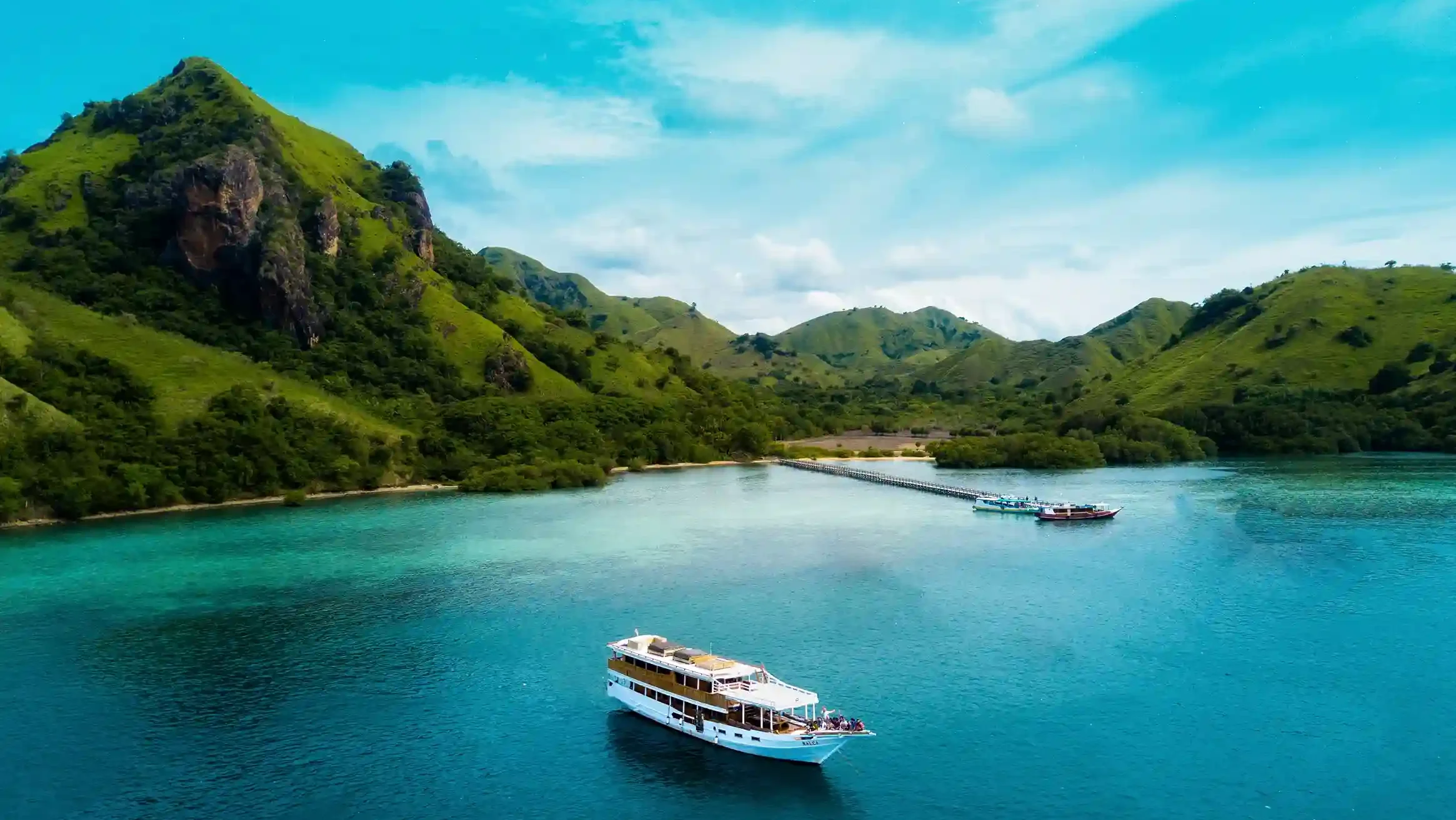
A phinisi boat enjoying the sunset near Kalong Island, in the Labuan Bajo area
A phinisi enjoying the sunset in the Labuan Bajo area, a common way to close out a multi-day Padar itinerary. Photo: Rohim Ari/Unsplash.

Once you’ve picked a length, the full cost breakdown shows what each itinerary above typically costs by boat class, and the boat charter guide covers how to actually book one of these routes with Komodo Luxury’s boat trip fleet.

Last updated: 24 August 2026.

Padar rarely stands alone

Almost every itinerary pairs the climb with something else, and the sequencing is nearly always the same for good reasons. Padar goes first, at sunrise or early morning while it is cool, and the water-based or wildlife stops follow. A full-day speedboat can take in Padar, a ranger-led dragon walk on Rinca and a short hill climb and swim at Kelor, provided you start early and accept tight transitions. Padar and Manta Point work well together on a day trip or the opening day of a liveaboard — anchor at Padar for the early hike, then continue to Manta Point in the late morning when the light improves for spotting rays, with the captain reversing the order if the wind builds.

Padar and Komodo dragons in one day is possible with a speedboat and a disciplined schedule: the sunrise climb, then straight to Rinca or Komodo Island for a short ranger walk, with very little slack for snorkelling. It is easier if you sleep in Labuan Bajo the night before and after so you are not also negotiating flights. But two days and one night is the honest recommendation — enough to add snorkelling and a slower pace without racing between docks, and enough buffer for the weather. A third day is worth it if you dislike pre-dawn starts, want flexibility, or hope to reach the quieter bays.

A workable two-day, one-night shape: Padar at sunrise, snorkelling or beach time through the middle of the day, anchor near Rinca or Komodo, dragon walk the second morning, one or two snorkel stops on the way back. Choose the overnight anchorage for shelter rather than proximity, and let the crew make that call.

Pink Beach is the other common partner and gives the day a useful contrast: the climb first to avoid the heat, then a longer stop in the water. If you are prone to seasickness, keep the main snorkelling for after the hike rather than before it. You stay on the same vessel throughout, with tenders running you ashore where needed.

For costs, a two-day Padar-focused trip varies enormously between a shared speedboat with a simple cabin and a private phinisi. The park-related component for a foreign visitor sits at roughly IDR 400,000–525,000 per day; everything above that is boat, fuel, meals and crew. A sunrise hike carries no extra park fee — the additional cost is entirely the boat and the pre-dawn sailing, which private speedboats and liveaboards price accordingly.

Padar or Kelor, and why people do both

Kelor is the short version. One hill, one main viewpoint over the surrounding sea and islands, a climb that is still steep but over quickly, and a good beach at the bottom. Padar is longer, higher, hotter and more structured, with multiple viewpoints along a ridge that invite you to stop, and a far more complex composition when you get there — layered ridges, contrasting bays, the volcanic shape of the park laid out.

For a first-time visitor wanting the iconic Komodo panorama, Padar is the priority and the longer climb is the price. Kelor makes more sense if your group includes young children, complete novices or people short on time, and many itineraries slot it in as a warm-up before Padar or a wind-down afterwards — which is genuinely useful, because it lets you gauge how everyone copes on a shorter hill first.

At sunset the two diverge again. Padar’s is grander, with the multi-bay view and the height, though low cloud can flatten the colour and you have to descend in fading light. Kelor’s is more intimate — closer views of nearby islands and boats — and its shorter trail is more forgiving for a dusk walk with a less confident group. Either way, carry a torch or headlamp. At sunrise, Padar is the classic dawn trek for photographers, while Kelor is gentler with a simpler foreground and usually fewer people, which makes it the reasonable alternative if a pre-dawn departure from Labuan Bajo does not appeal.

For panoramic photography specifically, Padar’s height and three-bay arrangement give it more to work with, and more distinct angles along the ridge; Kelor still delivers a good wide frame but with fewer foreground elements. Time of day, haze and cloud will do more to decide which feels rewarding on any given morning than the islands themselves.

The hike, the beach and the shape of the day
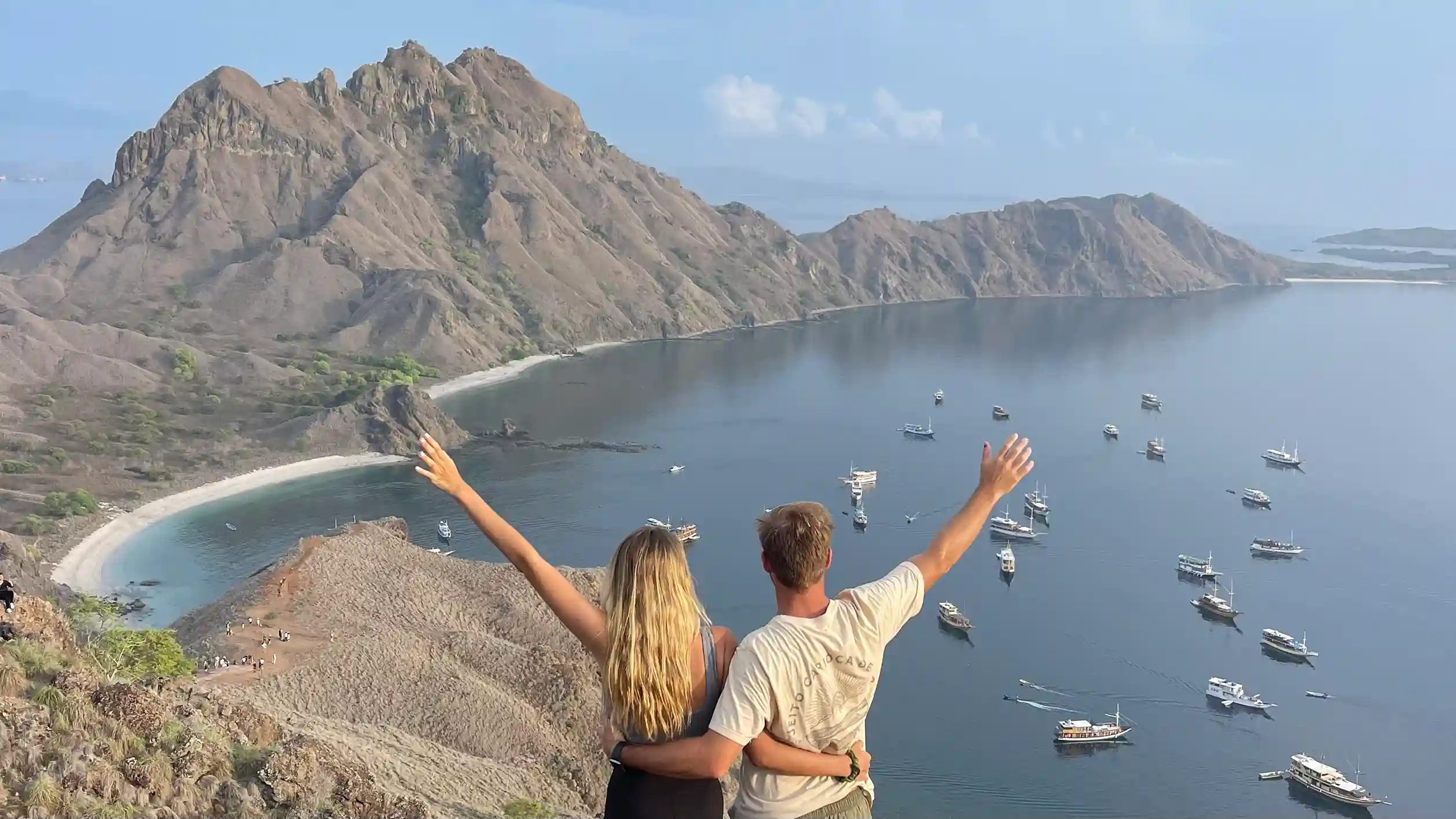
The plan on the island is simple: land at the jetty, walk steadily up the main staircase with short rests at each viewpoint, and return the same way. Most people take 25 to 45 minutes up and slightly less down, and it is worth building in time for photographs, water and a pause back at the beach before boarding.

Sunrise hikes work with children of around seven and up who can handle an early start and a lot of steps. The key is pacing — extra time, snacks, water, frequent stops at the intermediate viewpoints — and a headlamp for every person including the children, which makes the pre-dawn section much less anxious.

Padar’s beach is a working landing rather than a destination: a curved strip of sand with a jetty, used for boarding and disembarking. Sand colour and texture vary along the shore, currents sometimes make swimming unappealing, and there are no facilities, so most visitors are on the sand only briefly. For real beach time, itineraries look to nearby islands with better-known sand. The beaches do photograph well from above, where the curve of the shoreline and the shifting water colours read clearly; from ground level, including the hills or a boat for scale helps, and lower tide exposes more sand.

Light is best early and late, when the low sun angle emphasises the ridges and their texture. Midday is harsh and flat, though clearer if you are documenting the trail itself. Sunrise sessions are the busiest, so photographers who want space sometimes take the later slot and accept different light.

Geographically, Padar is a small volcanic island of steep ridges, deep bays and sparse vegetation that changes with the season, sitting between larger islands so the elevated viewpoints have long sightlines in several directions. The trails follow the natural contours, which is why the view opens progressively rather than all at once.

Two logistical notes. Entry runs on SiORA online reservations and QR e-tickets rather than a harbour counter — some operators fold that into their package and others expect you to arrange it, so confirm who is responsible before you travel. And transfers between Labuan Bajo harbour and your boat are normally organised by the operator, meeting at a designated pier with the crew loading luggage; if your hotel is outside the town centre, check whether transport to the pier is included.

Booking the trip itself

This site documents Padar Island; it does not sell tours. Bookings for the boats and packages described above are handled by Komodo Luxury, the operator within the same group as this publication.

Questions about a specific date or vessel go to WhatsApp +62 811-3823-875 or sales@komodoluxury.com.

This guide does not operate boats. Bookings are fulfilled by Komodo Luxury, and this site may earn a referral commission.

Interactive · routes to the plan that fits

Itinerary picker

Three choices and you land on the written itinerary that matches, plus the two or three pages that answer whatever that shape of trip usually raises next.

How long you have
How you want to travel
What you came for
Scroll to Top
Book with Komodo Luxury →
💬

Additional photo credits on this page: Killian Pham, Thomas Gabernig, Hongbin, Rohim Ari, Nott Peera, Simon Spring on Unsplash.