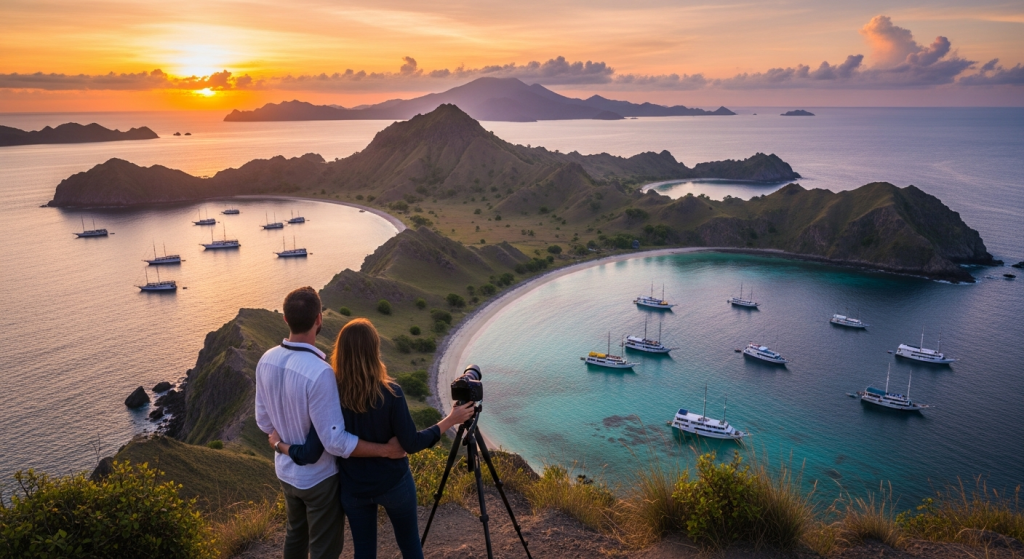
- Iconic viewpoint: Observe pink, black, and white sand beaches converging.
- Moderate hike: Approximately 800 steps to an elevation of 180 meters.
- UNESCO recognition: Part of the Komodo National Park World Heritage site since 1991.
The morning light catches the eastern ridge of Padar, painting the landscape in hues of ochre and gold. A cool breeze lifts from the Flores Sea, carrying the scent of salt and distant earth as the first rays illuminate the island’s distinct contours. This is the moment travelers seek: a vantage point unlike any other within Komodo National Park.
The Padar Island Ascent: A Three-Color Panorama Unrivaled
Padar Island presents a singular visual narrative within the archipelago. Here, the journey culminates not in a wildlife encounter, but in an expansive, almost cinematic vista. Arriving by phinisi or speedboat from Labuan Bajo, a 3 to 4-hour transit across the sapphire waters, visitors disembark onto a pristine white sand beach. The ascent begins immediately, a well-maintained trail of approximately 800 steps winding upward for 30 to 45 minutes. This moderate trek elevates one to 180 meters above sea level, offering a physical engagement with the landscape before the ultimate reward.
From the peak, the celebrated three-color beaches unfurl below. To the west, a stretch of ivory sand meets the turquoise expanse. Eastward, a distinct pink beach, its color derived from microscopic foraminifera, contrasts against the deep blue. Further still, a rare black sand beach, formed from volcanic activity, completes the triad. This geological anomaly is a primary draw for photographers and drone operators, seeking to capture the unique confluence of textures and shades. The Komodo National Park, established in 1980 and designated a UNESCO World Heritage site in 1991, protects this delicate ecosystem, ensuring its preservation for future generations. Daily visitor quotas are managed to maintain ecological balance. A typical day-trip itinerary often positions Padar as a sunrise or sunset destination, leveraging the dramatic light. The island itself is uninhabited, preserving its raw, untouched character. Guests typically spend 1.5 to 2 hours on Padar, including the hike and photography time at the summit, before continuing their journey through the park. This focus on landscape photography and panoramic views distinctly positions Padar Island within the broader Komodo experience, offering a different kind of immersion compared to its dragon-inhabited neighbors. The investment in a Padar Island visit is an investment in an iconic visual memory.
Rinca Island: Primal Encounters with Komodo Dragons
While Padar offers sweeping vistas, Rinca Island provides an intimate, primal encounter with the Komodo dragon. Located closer to Labuan Bajo, approximately 2.5 hours by boat, Rinca is often the first stop for visitors prioritizing wildlife. The island’s Loh Buaya ranger station serves as the primary gateway, where experienced park rangers, armed with forked sticks, guide small groups through the dry savannah. This guided walk, typically lasting 1 to 1.5 hours, focuses on locating Komodo dragons in their natural habitat. Rinca’s dragon population hovers around 1,500 individuals, offering a high probability of sightings.
The experience on Rinca is inherently different from Padar. Here, the focus shifts from expansive panoramas to concentrated observation of the world’s largest living lizard. Visitors walk along designated trails, observing these formidable reptiles, which can reach lengths of 3 meters and weigh over 70 kilograms. The rangers provide crucial safety briefings, emphasizing a safe distance of at least 5 meters from the dragons. While Rinca does not offer Padar’s iconic three-color beaches, it provides a direct connection to the park’s namesake creature. Families often find Rinca appealing due to the relatively flat terrain and the guaranteed wildlife spectacle. Photographers here capture close-up portraits of the dragons, a stark contrast to the wide-angle landscape shots on Padar. The Komodo National Park entrance fee, approximately IDR 150,000 for foreign visitors (excluding conservation and ranger fees), applies across all dragon-viewing islands. For travelers with limited time, Rinca can serve as an efficient alternative to Komodo Island for dragon sightings. However, it lacks the elevated viewpoint and the diverse beach palette that define a Padar Island visit.
Komodo Island: The Original Dragon Habitat and Beach Retreats
Komodo Island, the largest landmass within the national park, offers a blend of dragon encounters and leisurely beach experiences. Located approximately 4 hours by boat from Labuan Bajo, it represents the traditional heartland of the Komodo dragon. The main entry point, Loh Liang, features a ranger station and visitor facilities. Here, similar to Rinca, guided treks ranging from short (1-hour) to medium (1.5-hour) routes lead visitors through the dry forest and savannah, seeking the estimated 2,500 Komodo dragons inhabiting the island. These ancient reptiles, recognized as a vulnerable species by the IUCN Red List, have roamed these islands for millions of years.
Beyond the primary dragon encounter, Komodo Island also hosts Pantai Merah, commonly known as Pink Beach. This distinctive shoreline, one of only seven such beaches globally, derives its rosy hue from microscopic single-celled organisms called Foraminifera, which produce a red pigment on the coral reefs. When tiny fragments of red coral mix with white sand, the result is the striking pink shade. While Pantai Merah offers a beautiful setting for swimming and snorkeling, its panoramic scope differs significantly from Padar’s elevated viewpoint. On Padar, the three distinct beach colors are viewed simultaneously from a high vantage point, a geographical marvel. On Komodo Island, the Pink Beach experience is grounded, offering direct access to the unique sand and calm waters. Dive groups often combine a dragon trek on Komodo Island with snorkeling at Pantai Merah, followed by a dive at nearby sites like Manta Point or Batu Bolong. The island’s diverse offerings make it a strong contender for those seeking both wildlife and aquatic relaxation, providing a more rounded, multi-activity day compared to Padar’s singular, iconic viewpoint. For a truly iconic vista, however, the Padar Island trek remains .
Gili Laba (Gili Lawa Darat): Northern Vistas and Aquatic Access
For those seeking elevated perspectives beyond Padar, Gili Laba, specifically Gili Lawa Darat, offers a compelling, albeit different, alternative. Situated in the northern reaches of Komodo National Park, approximately 3.5 hours from Labuan Bajo, Gili Laba is particularly favored by multi-day phinisi charters and dive groups. The island presents a moderate hike, typically 20 to 30 minutes, to an elevation of 100-120 meters. From its summit, visitors are treated to a sweeping panorama of the surrounding turquoise bays and scattered islands, a classic Komodo seascape. The views are expansive, showcasing intricate coastlines and vibrant coral gardens visible through the clear waters.
While Gili Laba offers a beautiful viewpoint, it lacks the distinct three-color beach formation that defines Padar Island. The visual narrative here is one of intricate bay formations and verdant hills meeting the sea, rather than a unique geological convergence of sand types. Photographers often capture drone shots illustrating the serpentine inlets and the various shades of blue in the water, a different aesthetic from Padar’s stark contrasts. Gili Laba’s proximity to world-class dive sites, including the famous Manta Point, makes it a strategic stop for dive groups. Many itineraries combine a morning hike on Gili Laba with an afternoon spent snorkeling or diving with majestic manta rays, which can reach wingspans of up to 7 meters. The island’s relatively smaller scale and less-trafficked trails provide a sense of secluded discovery for some travelers. However, for the specific, iconic visual experience of seeing multiple distinct beach colors from a single, high vantage point, Padar Island maintains its unique position. The choice between Gili Laba and Padar Island often comes down to prioritizing either a classic island seascape with aquatic activities or the three-color beach spectacle.
The Cruising Experience: Phinisi Charters and Day-Trip Logistics
Accessing any of these remarkable islands within Komodo National Park hinges on the quintessential cruising experience. Labuan Bajo, the westernmost town on Flores Island and the gateway to the park, serves as the departure point for all expeditions. From its bustling harbor, a fleet of vessels, ranging from traditional wooden phinisi ships to modern speedboats, ferries visitors across the Flores Sea. Phinisi charters, renowned for their craftsmanship and comfort, often span 2 days and 1 night or 3 days and 2 nights, allowing for a comprehensive exploration of multiple islands, including Padar, Rinca, Komodo, and various dive sites. These vessels, typically 20 to 40 meters in length, provide luxury amenities, private cabins, and gourmet dining, catering to discerning travelers. The journey to Padar Island generally takes 3 to 4 hours by phinisi or 1.5 to 2 hours by speedboat, depending on sea conditions and vessel speed.
Day-trip options, primarily via speedboats, offer a more condensed itinerary, often visiting Padar, Komodo/Rinca, and a snorkeling spot like Manta Point within a single 8-10 hour excursion. While efficient, these trips involve less time at each location compared to the multi-day charters. The choice of vessel significantly impacts the travel experience: speedboats offer rapid transit, minimizing travel time between islands, while phinisi provide a more leisurely, experiential journey, allowing guests to savor the open sea and island sunrises/sunsets from onboard. The Komodo National Park entrance fees, which include conservation levies and ranger services, are applied per person per day, adding to the overall cost of the journey. Planning involves coordinating boat charters with flight arrivals at Labuan Bajo’s Komodo Airport (LBJ), which sees daily flights from Denpasar and Jakarta. Whether opting for a private yacht charter or a shared speedboat adventure, the logistics of reaching these remote islands are central to the Komodo National Park experience. The journey itself becomes an integral part of the adventure, leading to iconic destinations like Padar Island.
Deciding Your Komodo Itinerary: Prioritizing Perspectives
Choosing the ideal Komodo National Park itinerary ultimately hinges on individual priorities. For the UHNW traveler seeking that iconic, shareable image, Padar Island stands as the undisputed champion. Its unique three-color beach panorama, accessible via a moderate hike, offers a photographic opportunity elsewhere in the archipelago. This is the destination for drone enthusiasts, landscape photographers, and those desiring a truly distinctive visual memory. The commitment of time for the 45-minute ascent is a small investment for such a grand reward. Komodo National Park, as a UNESCO World Heritage site, ensures the preservation of these natural wonders.
Conversely, if the primary objective is a direct encounter with the Komodo dragon, Rinca Island or Komodo Island offer the most reliable opportunities. Rinca, with its higher dragon density near the ranger station and relatively easier treks, provides an efficient wildlife viewing experience. Komodo Island combines dragon sightings with the allure of Pantai Merah (Pink Beach), offering a blend of wildlife and relaxation. Gili Laba presents a beautiful alternative for panoramic island views, particularly appealing to those on multi-day charters who prioritize aquatic activities near Manta Point. Each island provides a distinct facet of the Komodo experience. Padar, however, remains the pilgrimage site for those who value the grandeur of a geological masterpiece, the satisfaction of a rewarding trek, and the capture of an image that transcends the ordinary. For a truly comprehensive understanding of the region, visit Indonesia Travel. The choice is not about superiority, but about aligning your travel desires with the specific magic each island offers. Padar Island’s unique topography ensures its place as a bucket-list destination.
Your journey through Komodo National Park begins with a vision. If that vision includes an panorama of three distinct beaches from a commanding viewpoint, a trek that rewards with an iconic photograph, and an experience that defines the very essence of the archipelago’s natural beauty, then Padar Island awaits. Explore our detailed itineraries and charter options to craft your perfect luxury adventure to this extraordinary destination. Visit padarisland.com to plan your bespoke Komodo experience and secure your passage to these magnificent vistas, ensuring every moment is as captivating as the view from the summit.